
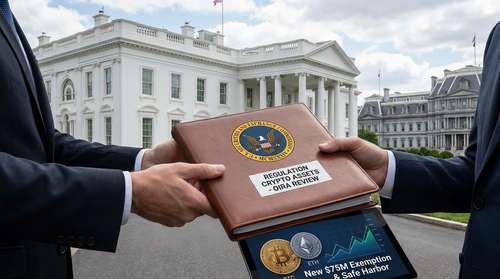
The era of regulation by enforcement in the United States digital asset sector is officially drawing to a close. This week, SEC Chair Paul Atkins confirmed that the agency’s landmark SEC Regulation Crypto Assets proposal has advanced to the White House Office of Information and Regulatory Affairs (OIRA) for final review. Marking a definitive pivot in U.S. crypto policy, the sweeping framework establishes clear operational guidelines for token issuers, including a highly anticipated $75 million annual fundraising exemption and formal token decentralization rules. For blockchain founders who have spent years navigating federal ambiguity, this development signals the arrival of a functional, compliance-focused market structure.
Unpacking the 'Regulation Crypto Assets' Proposal
Speaking at the inaugural Digital Assets and Emerging Technology Policy Summit hosted by Vanderbilt University and the Blockchain Association on Monday, Atkins laid out the structural mechanics of the incoming rules. Designed to provide an actionable path to compliance rather than punishing retroactive missteps, the proposal rests on three distinct regulatory pillars designed to support projects from their inception through maturity.
U.S. Crypto Fundraising Exemptions
The most immediate financial catalyst for the industry within the framework is the proposed fundraising exemption. Under the newly sculpted Paul Atkins crypto policy, token issuers will be permitted to raise up to $75 million over a rolling 12-month period. Companies utilizing this pathway will still maintain their access to other federal securities exemptions, preventing them from being locked out of traditional venture capital avenues.
Instead of navigating the prohibitive costs of standard public offerings—which have historically stifled early-stage web3 growth—issuers will operate under a tailored disclosure regime. This approach mandates principles-based disclosures, detailed financial statements, and ongoing operational transparency that protects retail investors without bankrupting the startup.
The Crypto Safe Harbor 2026 & Startup Runway
Early-stage blockchain developers face a notoriously steep barrier to entry, which the SEC aims to dismantle through a targeted startup exemption. Builders will receive a four-year operational window to raise up to $5 million without facing immediate, full-scale securities registration. This grace period recognizes the unique lifecycle of blockchain networks, which require capital and token distribution to build a user base long before the network becomes self-sustaining.
More importantly, the framework codifies an investment contract safe harbor—the ultimate goal for decentralized networks. Under the crypto safe harbor 2026 provisions, tokens can formally exit their classification as securities once the founding team successfully winds down the essential managerial efforts promised during the initial capital raise. This creates a verifiable, legal off-ramp for maturing projects that achieve true decentralization, resolving decades of debate over how the 1946 Howey Test applies to open-source software.
The SEC OIRA Review Process Explained
The submission to OIRA represents the final administrative hurdle before the rules go public. As a division of the Office of Management and Budget, an SEC OIRA review serves as the executive branch's clearinghouse, evaluating the cost-benefit analysis and interagency impact of all major federal regulations.
"We will have reg crypto that we will be proposing here shortly," Atkins noted at the Nashville summit. "It's in fact at OIRA right now, which is the next step before being published".
Once cleared by the White House, the framework will be published in the Federal Register. That publication triggers a formal public comment period where market participants, legal experts, and retail investors can weigh in on the technical mechanics. Atkins has specifically emphasized that the SEC wants marketplace feedback to ensure the safe harbors are workable in practice.
Moving Beyond 'Regulation by Enforcement'
The push toward definitive crypto regulatory clarity builds directly on the SEC and CFTC’s joint interpretive guidance released on March 17, 2026. That landmark document established a working taxonomy for digital commodities, stablecoins, and digital securities. Prior to these coordinated efforts, U.S. crypto companies were frequently forced offshore or buried in agency subpoenas as regulators relied on post-facto enforcement actions to dictate market operations.
The contrast between current agency actions and the previous administration's approach is stark. By establishing a rule-based standard for when a crypto asset is not subject to federal securities laws, the SEC is actively encouraging domestic capital formation. U.S.-based builders now gain a predictable pathway to launch and fund projects domestically, potentially reversing the massive offshore talent migration seen over the past few years.
A Bridge to Permanent Legislation
While the industry widely views these token decentralization rules as a structural victory, legal experts acknowledge that agency rulemaking alone is not a substitute for permanent law. Because SEC interpretations can technically shift with future changes in administration, statutory backing remains the ultimate objective.
The SEC’s current initiative serves as a pragmatic, transitional bridge. It is designed to protect investors and foster domestic innovation while Congress continues to debate comprehensive, bipartisan bills like the CLARITY Act and the GENIUS Act. Those legislative efforts have remained tied up in negotiations over stablecoin oversight and interagency jurisdictional boundaries.
Until Capitol Hill delivers a permanent statutory mandate, the SEC Regulation Crypto Assets package stands as the most consequential rulemaking effort for digital assets in U.S. history. Assuming the framework clears the OIRA review without major friction, American blockchain developers will finally possess a predictable, codified roadmap from early-stage launch to full network decentralization.