
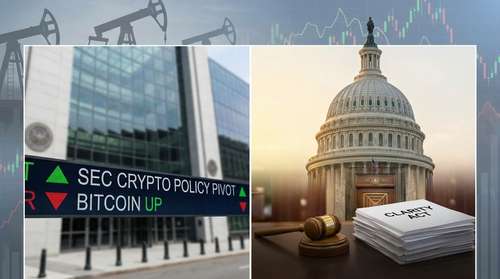
The regulatory landscape for digital assets is undergoing a seismic shift in Washington. Following a series of landmark SEC lawsuit withdrawals 2026, the agency has signaled a total course correction regarding its oversight of digital markets. This definitive pivot away from the contentious "regulation by enforcement" era arrives at a critical juncture, directly preceding the highly anticipated CLARITY Act crypto Senate vote. However, this historic legislative push to integrate digital assets into the core American financial system is unfolding against a backdrop of severe economic uncertainty, driven by the immediate Strait of Hormuz market impact.
The SEC Paul Atkins Crypto Policy Reverses Gensler-Era Crackdowns
On April 8, 2026, the Securities and Exchange Commission made a stark, unprecedented admission: its previous years-long crackdown on the cryptocurrency industry failed to deliver meaningful investor protection. Under the new SEC Paul Atkins crypto policy, the commission has formally dismissed high-profile, legacy enforcement actions against major exchanges, including Coinbase, Binance, and Gemini.
This pivot officially closes the chapter on the previous administration's aggressive tactics. The agency's recent fiscal enforcement report acknowledged that treating digital platforms purely through the lens of traditional securities violations was a fundamental misallocation of resources. Moving forward, Chairman Atkins emphasized that the commission is redirecting its focus exclusively toward substantive fraud and market manipulation, abandoning approaches that prioritized record-setting penalties over true investor security.
By dropping these foundational lawsuits, the agency has established a new evidentiary baseline. Defense counsel and compliance teams now have written, attributable records indicating that the government will no longer pursue standard operational practices as unregistered securities violations. Institutional capital can finally explore the digital asset market without the constant, looming threat of sudden regulatory litigation.
A High-Stakes Push for the Digital Asset Market CLARITY Act
The SEC's strategic retreat places the legislative ball firmly in the court of lawmakers. All eyes are now focused on the Digital Asset Market CLARITY Act, a sweeping bipartisan bill designed to formally divide jurisdictional oversight by transferring most digital commodities directly to the Commodity Futures Trading Commission (CFTC).
The political urgency surrounding the bill is palpable. On April 11, Senator Cynthia Lummis delivered a direct public warning to her colleagues: the Senate Banking Committee must move the legislation to a floor vote immediately, or the industry will face a legislative freeze until at least 2030 due to the impending November midterms. Former White House crypto coordinator David Sacks and Coinbase CEO Brian Armstrong have echoed this sentiment, urging Congress to adopt this future-proof framework without delay.
Clearing the Stablecoin Hurdle
This US crypto regulation update carries immense weight for the global financial ecosystem. A significant bottleneck that paralyzed the bill earlier in the year was resolved late last month via the Tillis-Alsobrooks compromise. The agreement bans passive yield on stablecoin balances while explicitly permitting activity-based rewards tied to platform use and payments. With the content of the legislation now largely settled, the only obstacle remaining is the Senate calendar.
For European investors, the adoption of the CLARITY Act would rapidly intensify competition with the European Union's MiCA framework, potentially accelerating the migration of digital asset development back toward United States markets.
Macro Turmoil: Navigating the Strait of Hormuz Market Impact
The push for legislative clarity is happening in an intensely volatile global economic climate. As of April 13, 2026, global markets are reeling from the execution of a naval blockade in the Strait of Hormuz, which immediately sent Brent crude oil futures surging past $100 per barrel.
The broader financial ecosystem is currently navigating unprecedented supply shocks. According to recent commodity tracking data, the closure of this vital geopolitical chokepoint has disrupted approximately 11 million barrels per day of crude production. This staggering event triggered immediate panic across trading desks, causing Asian and US stock futures to tumble heavily in early-week trading.
Investors are frantically assessing how this sudden energy shock will influence global monetary policy. With import inflation guaranteed to surge due to skyrocketing shipping costs and oil prices, central banks are likely to maintain higher-for-longer interest rates. This tightening liquidity environment directly influences capital flows across both traditional equities and alternative assets.
Bitcoin Price April 2026 Trends in a Fractured Market
This intersection of geopolitical turbulence and domestic regulatory relief is acting as a real-time stress test for digital commodities. Traders are closely analyzing Bitcoin price April 2026 trends as the asset attempts to balance conflicting market forces. On one hand, Bitcoin must navigate the broader liquidity contraction and risk-off sentiment sparked by the Middle East conflict. On the other hand, it is benefiting massively from the de-escalation of US regulatory hostilities.
Historically, severe oil shocks and rising inflation trigger broad sell-offs in risk-on assets. Yet, with the SEC effectively stepping out of the way and the Senate Banking Committee preparing for a historic markup session, institutional buyers are finding new structural incentives to allocate capital toward digital networks.
The coming weeks will undoubtedly define the trajectory of the digital economy for the rest of the decade. If lawmakers can secure the 60 votes required to pass the CLARITY Act amidst the noise of a global energy crisis, 2026 will be remembered as the year cryptocurrency secured its permanent legal foundation.