
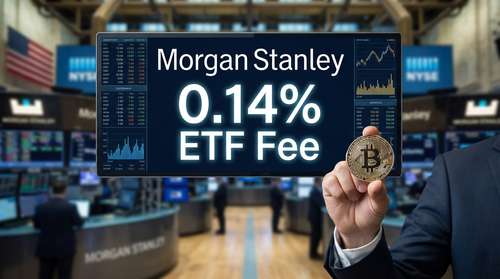
The landscape of digital asset investing just experienced a seismic shift. In a bold maneuver that caught many industry analysts by surprise, the upcoming Morgan Stanley Bitcoin ETF has officially filed to launch with a management fee of just 0.14%. By drastically undercutting the current market leaders, the financial titan is intentionally igniting a massive crypto fee war. As Wall Street asset managers scramble to protect their billions in assets under management, this aggressive pricing strategy signals a new era for institutional Bitcoin adoption where cost efficiency reigns supreme. The $83 billion spot Bitcoin ETF market, once dominated by a few early movers, is suddenly bracing for unprecedented competition.
For investors navigating the booming digital asset space, fees have suddenly become the ultimate battleground. The latest S-1 registration statement, filed with the U.S. Securities and Exchange Commission on March 28, 2026, details the mechanics of the Morgan Stanley Bitcoin Trust (ticker: MSBT). Expected to debut on the NYSE Arca in early April, the fund will utilize Coinbase and Bank of New York Mellon as its custodians. But the underlying structure isn't what has the financial world talking—it is the rock-bottom price tag.
The Dawn of a New Crypto Fee War on Wall Street
When spot cryptocurrency funds first hit the U.S. market, they revolutionized how traditional investors accessed digital money. Fast forward to today, and the initial land grab has evolved into a fierce war of attrition. Spot BTC ETF fees are now the primary weapon for firms fighting over market share.
Because all physically backed Bitcoin exchange-traded funds offer essentially identical exposure to the underlying asset, differentiation is nearly impossible. An investor holding shares in one fund gets the exact same price action as an investor in another. Recognizing this reality, Morgan Stanley decided to eliminate the only variable that truly matters: the cost to the consumer.
How the Morgan Stanley Bitcoin ETF Undercuts Rivals
To understand the magnitude of this move, look at the current heavyweight champions of Wall Street crypto news. BlackRock's iShares Bitcoin Trust (IBIT) and Fidelity's Wise Origin Bitcoin Fund (FBTC) both charge 0.25% annually. Until now, the absolute lowest Bitcoin ETF fee available was the Grayscale Bitcoin Mini Trust, sitting at 0.15%.
By setting the MSBT fee at a record-breaking 0.14%, Morgan Stanley isn't just shaving off a fraction of a percent; it is making a deliberate statement. The move completely strips away any pricing advantage held by incumbent funds, virtually guaranteeing that cost-conscious capital will naturally migrate toward the new, cheaper vehicle.
Why This Matters for Institutional Bitcoin Adoption
While reduced costs are fantastic news for retail buyers, the true target audience for MSBT operates on a much grander scale. Institutional Bitcoin adoption has historically been slowed by compliance hurdles, custody concerns, and, crucially, internal wealth management friction.
The Power of 16,000 Financial Advisors
Morgan Stanley is not just an asset manager; it is a global wealth management juggernaut. The bank employs approximately 16,000 financial advisors who collectively oversee more than $6 trillion in client capital. Before this in-house product existed, advisors wanting to provide clients with Bitcoin exposure had to steer them toward third-party funds. Recommending a higher-fee external product often creates conflict-of-interest concerns and introduces unnecessary compliance friction.
With MSBT priced at an industry-leading 0.14%, that barrier completely vanishes. Financial advisors can now seamlessly allocate capital to an internal vehicle without worrying about violating fiduciary duties regarding cost. Bloomberg ETF analysts recently highlighted that this vast advisory network acts as the ultimate gatekeeper to immense pools of generational wealth. If even a highly conservative 1% to 2% of Morgan Stanley's managed assets ultimately trickles into their proprietary fund, it would translate to tens of billions of dollars in immediate, organic demand.
What This Means for Your Bitcoin Investment Strategy
If you are currently holding shares in a higher-priced digital asset fund, this development should prompt a review of your portfolio. Switching from a fund charging 0.25% to one charging 0.14% might sound insignificant on paper, but over a multi-year horizon, those basis points compound into substantial capital.
Here is how you can adapt your approach:
- Evaluate Your Current Holdings: Check the expense ratio of your existing spot crypto funds. If you are currently paying anything over 0.20%, you are officially paying a premium for standardized exposure.
- Monitor the Response: Competitors like BlackRock and Fidelity are highly unlikely to sit idle while a major bank steals their market share. Watch for retaliatory fee cuts across the board in the coming weeks as the battle for dominance intensifies.
- Consider Tax Implications: Before liquidating a profitable existing position just to migrate to the Morgan Stanley fund, carefully calculate any potential capital gains taxes. A lower fee is excellent, but not if moving your assets triggers a disproportionately large tax event.
- Keep an Eye on the Broader Ecosystem: Morgan Stanley has also applied to custody digital assets and execute crypto trades, while filing for spot Solana and staked Ether ETFs. Their aggressive pricing strategy on Bitcoin will likely serve as a blueprint for how they handle upcoming altcoin products.
The Road Ahead for Spot BTC ETF Fees
The rollout of MSBT in early April 2026 will serve as a massive stress test for the entire digital asset ecosystem. We are witnessing the rapid commoditization of Bitcoin access. When a major Wall Street bank decides to use its flagship cryptocurrency product to aggressively attract and retain high-net-worth clients, the entire industry is forced to adapt.
As this crypto fee war escalates, the ultimate winners are the investors. The friction of moving capital from legacy fiat systems into digital assets has never been lower. Whether other major traditional finance institutions can match Morgan Stanley's unprecedented 0.14% threshold remains to be seen. But one thing is absolutely certain: the cost of owning Bitcoin on Wall Street has fundamentally changed forever, paving the way for the next massive wave of global adoption.