
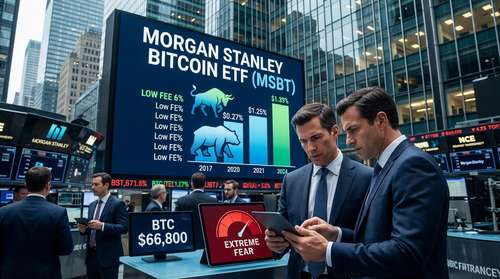
The global cryptocurrency market is facing a brutal collision of macroeconomic panic and unprecedented institutional expansion. As escalating Middle East tensions drive the crypto market fear and greed index to its lowest levels of the year, a massive catalyst is quietly brewing on Wall Street. Late last week, a global banking giant filed for a Morgan Stanley Bitcoin ETF, proposing a record-low fee structure that threatens to upend the current digital asset landscape.
While retail investors flee risk assets, pushing Bitcoin down to test the BTC price support 67k level—specifically stabilizing near $66,800—institutional gatekeepers are taking advantage of the volatility. The convergence of a potential Bitcoin short squeeze prediction and a renewed Bitcoin ETF fee war paints a complex picture for the weeks ahead.
The MSBT Crypto Filing: Undercutting the Giants
On March 27, Morgan Stanley submitted an amended S-1 registration statement to the U.S. Securities and Exchange Commission for the Morgan Stanley Bitcoin Trust. This MSBT crypto filing caught the industry off guard by proposing a staggering 0.14% management fee.
To put this aggressive pricing into perspective, it undercuts Grayscale’s Bitcoin Mini Trust by a single basis point and sits a full 11 basis points below BlackRock’s market-dominating iShares Bitcoin Trust (IBIT). If approved for listing on the NYSE Arca, with Coinbase and BNY Mellon handling custody and administration, this financial vehicle would make Morgan Stanley the first major U.S. bank to directly issue a spot Bitcoin ETF rather than simply distributing third-party products.
This strategic maneuver is deliberately designed to spark a Bitcoin ETF fee war across the $83 billion spot market. Morgan Stanley employs approximately 16,000 financial advisors who collectively manage $6.2 trillion in client assets. By offering an in-house product with rock-bottom fees, the bank removes any internal friction for advisors looking to recommend crypto exposure to their high-net-worth clients, effectively locking in massive distribution potential.
Macro Headwinds and the Extreme Fear Floor
The timing of Morgan Stanley's bold push contrasts sharply with current market sentiment. Over the weekend, geopolitical tensions involving the U.S. and Iran escalated severely, pushing Brent crude oil past $100 per barrel and triggering a broad risk-off selloff across global markets.
As a direct result, the crypto market fear and greed index plummeted to a reading of 13, firmly establishing an environment of Extreme Fear. Bitcoin dropped rapidly from the $70,000 range, suffering over $240 million in forced long liquidations within hours. However, the asset found a reliable floor as the BTC price support 67k zone held firm, with prices hovering around $66,800 in early Asian trading hours on Monday, March 30.
Whales Accumulate During the Panic
While retail traders capitulate, on-chain data reveals a different narrative among experienced market participants. Whale wallets added hundreds of thousands of coins throughout March, treating the geopolitical dip as a prime accumulation opportunity. This massive institutional and whale buying pressure provides a formidable backstop against further downward macroeconomic spirals, absorbing the retail panic selling almost entirely.
A Brewing Bitcoin Short Squeeze Prediction
The current market structure has led several prominent financial analysts to issue a contrarian Bitcoin short squeeze prediction. The mechanics are straightforward: extreme negative funding rates and an aggressively high volume of short positions have saturated the derivatives market. Traders are overwhelmingly betting on further downside due to the Middle East crisis and inflation fears.
However, if the macroeconomic shock is absorbed and the $66,800 floor continues to hold, these heavily leveraged short positions become highly vulnerable. The fundamental catalyst of the Morgan Stanley Bitcoin ETF moving closer to a projected early April launch could trigger a rapid reversal. When institutional capital inflows meet an overcrowded short market, the resulting buying pressure forcibly unwinds bearish bets, potentially rocketing prices back above the $70,000 resistance level in a matter of hours.
Defining Institutional Crypto Adoption 2026
What we are witnessing is a profound structural shift in how traditional finance interacts with digital assets. The bank's transition from a mere distributor of crypto products to a direct issuer marks a pivotal milestone for institutional crypto adoption 2026.
Morgan Stanley’s ambitions extend far beyond a single Bitcoin fund. The institution has also filed applications for spot Solana and staked Ethereum ETFs earlier this year, and recently applied for a national trust banking charter to custody digital assets directly.
By weaponizing its immense advisory network and intentionally triggering a Bitcoin ETF fee war, Wall Street’s traditional gatekeepers are sending a clear message. The short-term price action might be dictated by temporary geopolitical fears, but the long-term financial infrastructure is being built for massive, sustained capital deployment. Investors waiting for absolute macroeconomic certainty may find themselves priced out when the geopolitical dust finally settles and institutional distribution begins in earnest.