
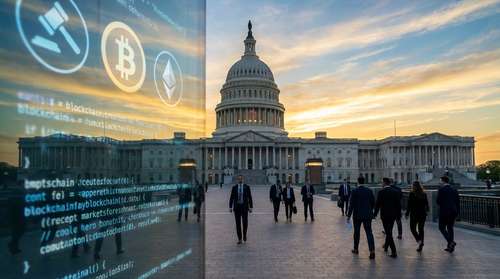
The digital asset industry is bracing for a watershed legislative moment. According to the latest CLARITY Act crypto update, a high-stakes breakthrough has emerged in the U.S. Senate. After months of partisan gridlock and fierce lobbying from both traditional finance and Web3 innovators, the Digital Asset Market CLARITY Act is officially advancing to the Senate Banking Committee for its highly anticipated final markups, beginning April 13, 2026.
This comprehensive US Senate crypto bill 2026 represents the most significant attempt to date to replace 'regulation by enforcement' with a robust statutory structure. If passed, the legislation will permanently redefine how digital assets are traded, how custody rules are enforced, and how decentralized finance (DeFi) platforms operate within the United States.
The Urgency Behind the Crypto Regulation Breakthrough
With the November 2026 midterm elections looming, lawmakers are facing a rapidly closing window. Senator Cynthia Lummis recently warned that failing to pass the legislation now could stall federal crypto reform until at least 2030. Echoing this urgency, former White House AI and crypto czar David Sacks, alongside Treasury Secretary Scott Bessent, have publicly pushed for swift passage so President Donald Trump can sign the landmark bill into law.
The momentum for a crypto regulation breakthrough accelerated following a tentative agreement between key committee members and industry leaders. While the House of Representatives overwhelmingly passed the base text (H.R. 3633) with bipartisan support in July 2025, the Senate version required delicate, high-stakes negotiations. Now, as the Senate returns from its Easter recess, Chairman Tim Scott and the Banking Committee are tasked with finalizing a compromise that satisfies both consumer protection advocates and pro-innovation voices.
Resolving the SEC vs CFTC Jurisdiction Battle
For years, a central roadblock to market stability has been the bureaucratic turf war over token classification. The CLARITY Act introduces a bright-line test that explicitly establishes SEC vs CFTC jurisdiction.
Under the proposed framework, the Securities and Exchange Commission (SEC) will maintain oversight over digital assets that strictly behave as investment contracts. Meanwhile, the Commodity Futures Trading Commission (CFTC) will be granted exclusive regulatory authority over digital commodities—assets whose value is intrinsically tied to blockchain utility and decentralized networks. By drawing these definitive regulatory lines, the bill aims to shield software developers and peer-to-peer network validators from surprise enforcement actions, providing a crucial safe harbor for early-stage blockchain projects.
This clear demarcation is widely considered the foundation of modern digital finance. For years, overlapping jurisdictions left crypto startups in an impossible position, often facing dual investigations for the exact same digital asset offerings. The new framework finally modernizes financial law for the digital age, reducing frivolous lawsuits and promoting responsible innovation onshore.
Defining the Stablecoin Federal Framework and Yield
Perhaps the most contentious element of the legislative package involves the stablecoin federal framework. Traditional banking institutions have lobbied intensely against allowing crypto exchanges and stablecoin issuers to offer yield-bearing accounts. Banking lobbyists argue that such incentives could spark massive deposit flight from traditional savings accounts and subsequently make lending harder.
However, recent signals suggest a compromise is firmly on the horizon. Coinbase Chief Legal Officer Paul Grewal noted just days ago that negotiations surrounding the stablecoin yield dispute are 'very close to a deal'. The pending agreement reportedly balances the banking sector's liquidity concerns with the crypto industry's demand for competitive yield incentives. Resolving this final hurdle remains the cornerstone of the Banking Committee's April markup agenda.
Balancing Innovation and Market Protections
Beyond yield, the stablecoin provisions build upon the critical groundwork laid by the 2025 GENIUS Act. The legislation demands rigorous reserve requirements for major stablecoin issuers, ensuring that tokens used for retail payments and real-world commerce are subject to stringent federal oversight. This approach keeps the United States competitive while ensuring that everyday consumers are insulated from the risk of sudden market instability.
Furthermore, the legislation requires centralized intermediaries interacting with DeFi protocols to adhere to strict risk management and cybersecurity standards. By concentrating regulatory efforts on points of control rather than penalizing the underlying open-source code, lawmakers have crafted a nuanced approach to consumer safety that does not stifle technological progress.
Paving the Way for Institutional Crypto Adoption
The implications of this bill extend far beyond Washington. Wall Street analysts predict that establishing a predictable regulatory environment will act as a massive catalyst for the broader digital economy, particularly regarding institutional crypto adoption.
Pension funds, insurance companies, and major asset managers have long cited regulatory ambiguity as their primary barrier to entry. A finalized statutory framework will give compliance departments the legal certainty needed to safely integrate digital assets into diversified portfolios. Furthermore, rigorous market structure standards for centralized crypto exchanges, custodians, and broker-dealers will heavily mitigate the risks of another FTX-style collapse, restoring deep institutional trust.
As the Senate Banking Committee gavels in for the historic April 13 markup, the stakes could not be higher. The digital asset market is watching closely to see if Congress can successfully bridge the gap between traditional finance and decentralized innovation. If successful, the Digital Asset Market CLARITY Act will not only legitimize the U.S. crypto sector but firmly establish the United States as the global epicenter for blockchain technology.