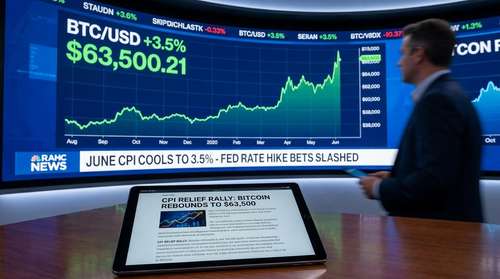

On March 24, 2026, the global financial landscape is witnessing a staggering divergence. As escalating conflicts in the Middle East and spiking oil prices trigger severe risk-off sentiment in traditional equities, the world's largest cryptocurrency has surged back to the $71,700 level. This unprecedented BTC decoupling from Nasdaq and the S&P 500 signals a permanent shift in institutional capital allocation. Investors are no longer treating the asset as a highly correlated speculative tech play. Instead, amidst geopolitical instability, the Bitcoin digital gold hedge narrative is proving its merit in real time.
The Energy Crisis and Institutional Flight to Safety
The macroeconomic backdrop is increasingly fragile. Recent military strikes near Iranian natural gas infrastructure in Isfahan, coupled with a tense ultimatum delivered to Tehran, have sent energy markets into a frenzy. With Brent crude aggressively pushing past $113 a barrel and Goldman Sachs projecting even higher spikes if shipping lanes remain blockaded, Wall Street is pricing in a massive, prolonged inflationary shock.
Higher energy costs inevitably force central banks into a corner, reviving fears of runaway inflation and accelerated fiat currency debasement. Consequently, the national debt impact on Bitcoin is becoming impossible to ignore. As sovereign debt spirals to fund defensive and economic measures, institutional wealth is rapidly migrating toward mathematically capped, decentralized assets. Dominating crypto market news March 2026, this flight to safety explains why Bitcoin remains resilient while tech-heavy indices bleed.
Landmark SEC/CFTC Ruling Cements Bitcoin Commodity Status 2026
Price action is only half the story. The underlying structural foundation for this rally was solidified on March 17, when the SEC and CFTC published a historic 68-page joint interpretive release. For the first time, federal regulators explicitly classified Bitcoin, Ether, Solana, and 13 other major cryptocurrencies as digital commodities.
This monumental decision formally removes the Howey Test overhang that has plagued the industry for over a decade. By establishing definitive Bitcoin commodity status 2026, regulators have effectively de-risked the asset class for conservative institutional compliance departments. Crucially, the guidance clarifies that network mining, staking, and basic protocol operations fall completely outside of securities law. While the industry awaits the final passage of the CLARITY Act to enshrine these rules into permanent legislation, the immediate regulatory clarity has unblocked the pipeline for massive capital deployment.
How Institutional Bitcoin ETF Inflows Drive the Market
Interestingly, the push above $71,700 is not being driven by a retail frenzy. In fact, spot market trading volumes on major offshore exchanges like Binance dropped to multi-year lows of roughly $52 billion earlier this month. So, who is buying?
The answer lies in traditional finance and regulated wrappers. Institutional Bitcoin ETF inflows are quietly absorbing the available supply, creating a robust price floor that prevents severe drawdowns. While heavily leveraged short-sellers face brutal squeezes—over $44 million in short positions were liquidated in a single hour during the recent surge—traditional asset managers are steadily accumulating. Exchange flow data reveals a stark contrast: offshore retail venues are seeing a notable drop in speculative activity, while U.S.-regulated platforms catering to institutional buyers show sustained holding patterns and negative premiums, indicating that coins are being moved into cold storage rather than actively traded.
The Hormuz Premium: A Stress Test for Miners
While investors celebrate the decoupling, the network's infrastructure faces a unique challenge. Electricity accounts for the vast majority of Bitcoin mining expenses, and the current energy shock is introducing what analysts call the 'Hormuz Premium'. As natural gas and industrial electricity tariffs rise in tandem with global oil prices, the break-even threshold for miners is skyrocketing. This dynamic will likely force inefficient, older-generation mining rigs—such as the Antminer S19 series—offline as their margins go deeply underwater. However, the protocol's self-adjusting difficulty algorithm ensures that the network remains perfectly secure, paradoxically highlighting the system's industrial resilience to macroeconomic shocks.
Bitcoin Price Prediction 2026: The Road to $80,000
Looking ahead, the market structure has fundamentally changed. We are no longer dealing with an asset reliant on zero-interest-rate liquidity. Between the explicit regulatory green light from the SEC and CFTC, a worsening global energy crisis, and relentless institutional demand, the overarching thesis has been validated.
Any credible Bitcoin price prediction 2026 must now factor in this new macroeconomic and regulatory reality. The asset is currently defending critical technical convergence points, particularly the moving average support zones near $70,400. If the bulls successfully consolidate above the $71,700 resistance band and flip it into support, technical indicators and liquidation maps suggest an explosive path toward the $80,000 threshold. Conversely, a failure to hold $69,100 could see a brief retest of the $67,000 range, but the broader institutional bid remains firm. For the first time in its history, Bitcoin isn't just surviving a global macro crisis—it is thriving precisely because of it.