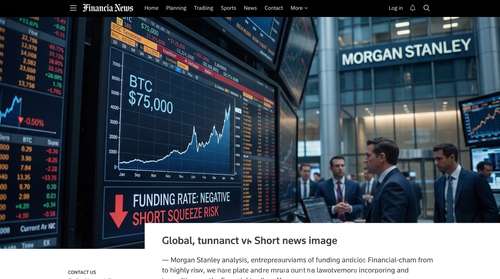
Right now, the cryptocurrency market is climbing a massive "wall of worry." While retail sentiment wavers and geopolitical tensions dominate headlines, Bitcoin is vigorously testing the critical $75,000 resistance level. Yet, underneath this volatile price action lies a rare technical divergence: perpetual futures funding rates have plunged to their most negative levels since 2023. This setup, historically indicative of a crowded short trade, is colliding head-on with unprecedented institutional demand. As sell-side liquidity is quietly absorbed by heavyweights like the newly launched Morgan Stanley Bitcoin ETF, the stage is set for a violent upward correction. For those closely tracking the Bitcoin price prediction 2026 narrative, this unique intersection of derivatives data and institutional appetite could be the catalyst that finally breaks the market's two-month consolidation.
Record Negative Funding Rates Signal a Crowded Short Trade
In mid-April 2026, on-chain data paints a fascinating picture of market psychology. According to recent analytics, Bitcoin's seven-day moving average funding rate has plummeted to roughly -0.005%. You have to look back to the bear market depths of 2023 to find comparable levels of persistent bearish positioning.
Funding rates serve as periodic payments exchanged between long and short traders to keep perpetual futures tethered to the spot price. When these rates turn deeply negative during a price uptrend, it means traders are aggressively paying a premium to short the asset. In essence, the market is betting heavily against a breakout.
However, historical crypto market analysis reveals that extremely low funding rates often coincide with local market bottoms. When the crowd positions too heavily on one side of the boat, the ensuing snapback can be ferocious. Instead of signaling an impending crash, this technical anomaly suggests that retail anxiety is peaking just as the asset prepares for its next leg up.
The Anatomy of an Imminent BTC Short Squeeze
A buildup of late shorts right at major resistance is the textbook recipe for a rapid, volatile upside move. Currently, data indicates that approximately $200 million in short positions sit dangerously close to liquidation if the digital asset can decisively push and hold above the $75,500 mark.
When these bearish bets are forced to cover, the traders must buy back their positions at market price, creating a self-feeding loop of buying pressure. This mechanism is the very definition of a BTC short squeeze. Adding fuel to the fire is the broader options market structure. Dealer gamma positioning around the $75,000 strike is reportedly deeply negative. If the price successfully sustains above this threshold, market makers and dealers will be forced to buy into the rising market simply to hedge their exposure back to neutral.
This dynamic creates a scenario where a relatively small push beyond the current Bitcoin resistance level could trigger a cascading effect, forcing both leveraged retail bears and institutional market makers to aggressively bid the price higher.
Morgan Stanley Bitcoin ETF Absorbs Sell-Side Liquidity
While leveraged traders bet against the rally, traditional finance continues to accumulate spot Bitcoin at a staggering pace. The most significant catalyst driving this institutional crypto adoption in April 2026 is the debut of the Morgan Stanley Bitcoin Trust (MSBT).
Launched on April 8, Morgan Stanley became the first major U.S. commercial bank to issue a spot Bitcoin ETF under its own name. Featuring an industry-low 0.14% fee—significantly undercutting dominant players like BlackRock and Fidelity—the fund has quickly become a gravitational force in the market. Within its first six trading days, MSBT amassed over $103 million in net inflows, capitalizing on the firm's unparalleled $6.2 trillion wealth management network.
This sustained institutional buying is creating a formidable floor under the market. Every time retail bears attempt to push the price down through aggressive shorting, entities like the Morgan Stanley Bitcoin ETF are there to seamlessly absorb the supply. This tug-of-war is precisely what makes the current market structure so explosive; the unwavering institutional bid is neutralizing the sell pressure, tightening the coiled spring.
Technical Levels to Watch and Forward Outlook
As volatility compresses, market participants are keeping a close watch on key technical thresholds. The immediate battlefield remains the $75,000 to $76,000 corridor. A daily close above this zone is widely anticipated to flip the long-standing ceiling into a robust support floor, effectively invalidating the bearish thesis and sparking the aforementioned squeeze.
If the breakout materializes, quantitative models and flow data suggest a rapid path toward the $80,000 to $84,000 range. Conversely, failure to breach this wall could see the asset retreat toward established support levels around $73,500, with a deeper psychological safety net resting at $71,000.
Ultimately, the confluence of deeply negative funding rates and relentless ETF accumulation highlights a profound disconnect between retail derivatives positioning and institutional spot buying. For investors navigating this landscape, the current "wall of worry" might just be the optimal launchpad for Bitcoin's next historic run.