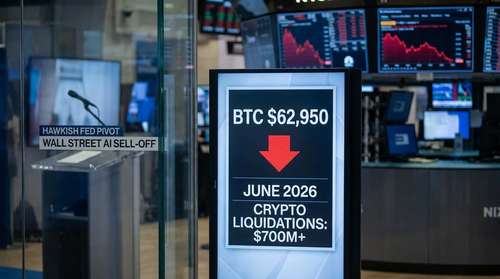

February 14, 2026 – The romance is officially over for Bitcoin investors this Valentine’s Day. What was supposed to be a season of recovery has turned into a nightmare scenario as the world’s largest cryptocurrency clings precariously to the $66,000 support level, marking a devastating 48% retracement from its October 2025 all-time high of $126,080. In a chilling new research note released this morning, Standard Chartered has issued a stern warning: the Bitcoin price crash of 2026 is not finished, and a final "capitulation" event could drag prices down to $50,000 before any sustainable recovery begins.
Standard Chartered BTC Forecast: The Path to $50,000
The latest bearish signal comes from Geoffrey Kendrick, Standard Chartered’s Global Head of Digital Assets Research, who has historically been one of the street’s most optimistic voices. In a reversal that has rattled already fragile markets, Kendrick slashed the bank’s year-end 2026 target from $150,000 to $100,000, warning that the immediate future holds "more pain" for holders.
“We are staring at a textbook capitulation phase,” Kendrick wrote in the note to clients. "The market has failed to sustain the $70,000 floor, and with macro headwinds intensifying ahead of the Federal Reserve transition in June, we see a high probability of a flush down to the $50,000 region to clear out remaining leverage."
This revised Standard Chartered BTC forecast suggests that while the long-term thesis remains intact, the short-term market structure has fractured. The bank cites a "severe deterioration" in sentiment among retail investors who entered the market during the Q4 2025 mania, many of whom are now sitting on steep unrealized losses.
Bitcoin ETF Outflows February: An $800 Million Exodus
Driving this bearish outlook is a massive reversal in institutional flows. Data from SoSoValue confirms that Bitcoin ETF outflows in February have reached alarming levels. In the week leading up to Valentine's Day alone, U.S. spot Bitcoin ETFs saw a staggering $800 million in net withdrawals, marking the fourth consecutive week of bleeding.
The "Underwater" ETF Buyer
The core of the problem, according to Standard Chartered’s analysis, is the average entry price of the institutional class. "The average ETF buyer is now underwater, with a cost basis estimated around $90,000," Kendrick explained. "Unlike the 'HODLers' of previous cycles, these are price-sensitive traditional finance investors who are rushing for the exits as volatility spikes."
BlackRock’s iShares Bitcoin Trust (IBIT) and the Fidelity Wise Origin Bitcoin Fund (FBTC) – once the engines of the 2025 bull run – have accounted for nearly 60% of this month’s outflows. Total assets under management in Bitcoin ETFs have plummeted from their October peak of $165 billion to just under $96 billion, signaling a massive retreat in institutional confidence.
Legislative Deadlock: The Digital Asset Market Clarity Act Delay
Adding fuel to the fire is the paralysis in Washington. The highly anticipated Digital Asset Market Clarity Act delay in the U.S. Senate has left the industry in regulatory limbo. Despite passing the House in July 2025, the bill – which promised to finally distinguish between securities and commodities – has stalled in the Senate Banking Committee.
SEC Chair Paul Atkins, who replaced Gary Gensler late last year, testified earlier this week urging Congress to act. "We need a firm grounding in statute," Atkins told the committee, warning that regulation by enforcement is no longer viable. However, partisan disagreements over stablecoin provisions and conflict-of-interest clauses have led to a legislative stalemate.
Market analysts believe this uncertainty is keeping sideline capital frozen. "Without the CLARITY Act, institutions simply cannot justify allocating fresh capital to a falling knife," notes crypto policy analyst Sarah Vartanian. "The market priced in regulatory clarity for early 2026, and that premium is now being unwound."
BTC Price Support Levels and Technical Outlook
Technically, the picture is grim. Bitcoin is currently testing the 200-week moving average, a critical trendline that has historically marked the bottom of bear markets. The failure to hold the $69,000 level—the cycle peak from 2021—was a major psychological blow.
If the current BTC price support levels at $65,000–$66,000 fail, the next major zone of interest is $60,000. Below that, there is very little structural support until the $50,000 psychological barrier predicted by Standard Chartered. This level also coincides with the 0.618 Fibonacci retracement level of the entire 2023-2025 bull run.
"The bulls are exhausted," says veteran trader Peter Brandt. "We are seeing a classic 'descending triangle' formation that typically resolves to the downside. Unless we see a miraculous reclaim of $72,000 this week, the path of least resistance is lower."
Crypto Market Capitulation: Is the Bottom Near?
Despite the bloodshed, some contrarian indicators suggest the worst may soon be over. The "Fear and Greed Index" has hit "Extreme Fear" (12/100) for the first time since the FTX collapse, a signal that historically precedes market bottoms. Furthermore, Standard Chartered’s Kendrick notes that the upcoming transition at the Federal Reserve—with Kevin Warsh expected to replace Jerome Powell in June 2026—could bring the liquidity injection markets are desperate for.
"We expect the crypto market capitulation to complete by Q2 2026," Kendrick concluded. "Once the weak hands are flushed out at $50,000, we anticipate a sharp V-shaped recovery leading into the second half of the year."
For now, however, Bitcoin investors are left nursing their portfolios, hoping that this Valentine’s Day heartbreak is merely the darkness before the dawn of the next bull cycle.