
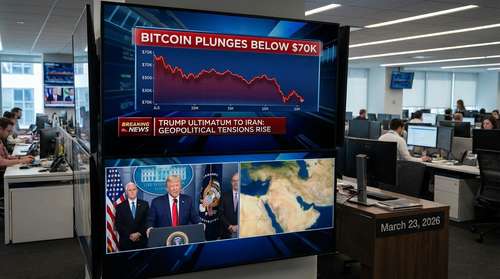
The digital asset ecosystem is experiencing severe turbulence this week as geopolitical shockwaves reverberate across global financial networks. The severe Bitcoin price crash March 23 2026, which dragged the world's leading cryptocurrency down to $68,000, has completely altered the market's trajectory over the past 48 hours. If you are logging into your portfolio and wondering why is crypto down today, the catalyst is decidedly macroeconomic rather than technical. The sharp downturn is closely tied to the latest escalation in the Middle East conflict 2026, specifically driven by the immediate market reaction to President Trump's aggressive 48-hour ultimatum directed at Iran.
The Trump Iran Ultimatum Impact on Risk Assets
Historically, Bitcoin has been touted by some macroeconomic advocates as a safe-haven asset, akin to digital gold. However, the events of the past two days have reinforced its short-term tendency to trade as a high-beta risk asset during sudden geopolitical panics. The Trump Iran ultimatum impact was felt almost instantly across Asian and European trading sessions. When the White House issued its stark warning, the immediate reflex of institutional allocators was to flee risk. We witnessed a widespread flight to traditional safety vehicles, namely short-dated US Treasuries, the US Dollar Index (DXY), and physical gold.
Traders are intensely monitoring the escalating rhetoric. A potential military confrontation naturally disrupts global energy supply chains, pushing crude oil prices higher and threatening a resurgence in sticky inflation. For the crypto sector, this macroeconomic domino effect means a severely diminished appetite for speculative investments. With the looming deadline set by the administration, cautious investors opted to reduce their exposure to highly volatile assets, pushing Bitcoin below 70000 today and breaking a critical psychological barrier that had previously buoyed market sentiment throughout the spring.
Inside the $240 Million Crypto Market Liquidations Report
The swiftness of the decline caught thousands of derivative traders entirely off guard. According to the latest crypto market liquidations report, more than $240 million in leveraged positions were violently wiped out across major centralized exchanges in a matter of hours. The vast majority of these were heavily leveraged long positions held by traders who had mistakenly anticipated a quick recovery above the $72,000 resistance mark.
When the news from Washington first hit the wires, initial spot market selling forced the price slightly lower. This sudden, sharp dip triggered an automated cascade of margin calls. Exchanges were contractually forced to liquidate underwater long positions, which in turn created artificial sell pressure on the order books, dragging the spot price down even further. This vicious cycle of forced selling is precisely what transformed a standard technical correction into a violent flush, landing the flagship cryptocurrency squarely in the $68,000 range.
Shifting Institutional Sentiment
It isn't merely retail margin traders feeling the burn of this liquidation cascade. Spot market inflows, particularly regarding US-based exchange-traded funds (ETFs), have abruptly cooled. Portfolio managers and large-scale allocators generally despise uncertainty, and a rigid, ticking-clock ultimatum between a global superpower and a heavily armed regional player provides exactly the kind of unquantifiable risk they seek to avoid. Capital preservation has abruptly replaced aggressive accumulation as the dominant strategy on Wall Street this week.
Crucial Bitcoin Price Support Levels to Monitor
With the broader market still heavily reactive to breaking news alerts out of the Middle East, technical analysts are busy mapping the downside risk. The painful loss of the $70,000 handle has shifted immediate focus to lower historical floors. The most critical Bitcoin price support levels now sit tightly between $65,500 and $64,000. This specific structural zone historically represents a massive volume node where institutional buyers previously stepped in to accumulate earlier this year.
If the geopolitical situation deteriorates further once the 48-hour window expires, a confirmed daily close below $64,000 could open the technical trapdoor toward the 200-day moving average, currently hovering closer to the $59,000 to $60,000 region. Conversely, if back-channel diplomatic efforts yield a sudden de-escalation, the $70,000 mark will quickly transition from a comfortable support floor into a heavy resistance ceiling that bulls will need to conquer all over again.
Navigating the Days Ahead
The next few days are undeniably pivotal for both traditional and decentralized finance. Traders must remain hyper-vigilant, keeping one eye on standard technical indicators and the other firmly fixed on international news feeds. The current volatility serves as a stark reminder that digital currencies do not exist in an isolated vacuum. They remain intricately woven into the broader global economic and geopolitical fabric.
Until the intense uncertainty surrounding the White House's ultimate stance on Tehran is resolved, market participants should brace for erratic, headline-driven price action. Proper risk management and reduced leverage are absolutely essential right now, as highly reactive markets are notoriously unforgiving to over-exposed investors.