
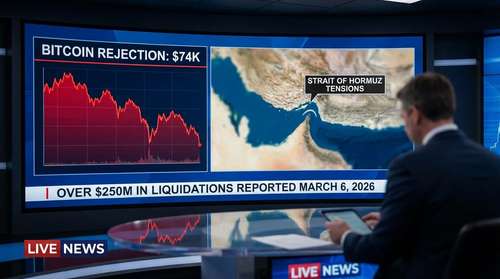
The global cryptocurrency market is reeling today, March 6, 2026, after Bitcoin (BTC) faced a sharp rejection at the critical $74,000 resistance level, triggering a broader sell-off. The sudden downturn has wiped approximately 2% off the total crypto market capitalization, dragging it down to $2.48 trillion. This bearish momentum was significantly accelerated by escalating geopolitical tensions in the Strait of Hormuz, which have spooked investors and prompted a swift capital rotation into traditional safe-haven assets.
Crypto Market Crash Today: Bitcoin Fails to Break $74K
Bitcoin's attempt to secure a new all-time high above $74,000 failed spectacularly in the early hours of trading, sending the premier cryptocurrency tumbling back toward the $70,000 support zone. Technical analysts had warned that the $74k level was a "make-or-break" zone, and the inability to sustain bullish momentum has resulted in a classic "bull trap" scenario.
Market data indicates that this rejection was not merely a technical correction but a liquidity flush. As BTC price slipped, it triggered a cascade of stop-loss orders, resulting in a rapid 2.5% intraday drop. "The $74,000 level has proven to be a formidable psychological barrier," notes senior market analyst Sarah Jenkins. "Without sufficient volume to break through, the market naturally sought lower liquidity levels, catching over-leveraged bulls off guard."
Strait of Hormuz Tensions Rattle Global Finance
Adding fuel to the fire, reports of intensifying military maneuvers in the Strait of Hormuz—a vital chokepoint for global oil transit—have sent shockwaves through financial markets. Historically, geopolitical instability drives investors toward gold and the U.S. dollar, often at the expense of risk-on assets like cryptocurrencies.
On March 6, 2026, crude oil prices spiked in response to the unrest, renewing fears of global inflation. This macroeconomic uncertainty has forced institutional investors to de-risk, pulling capital from volatile crypto markets. The correlation between the Strait of Hormuz conflict and the crypto market dip highlights Bitcoin's ongoing struggle to decouple from traditional geopolitical risk factors.
Liquidations Top $250 Million as Longs Capitulate
The sudden price reversal unleashed havoc on derivatives markets. According to data from Coinglass, the market has witnessed over $250 million in liquidations in the last 24 hours alone. The vast majority of these were long positions, totaling nearly $167 million, as traders betting on a breakout were forced to close their positions at a loss.
Bitcoin Long Liquidations Report
Bitcoin led the liquidation charts, with over $86 million in long positions wiped out. Ethereum (ETH) followed closely, shedding nearly $50 million in leveraged bets. This "long squeeze" has removed significant leverage from the system, potentially setting the stage for a period of consolidation. However, the sheer volume of liquidations suggests that the market was overheated and due for a reset.
Crypto Fear and Greed Index Plunges to "Extreme Fear"
Investor sentiment has taken a massive hit alongside prices. The Crypto Fear and Greed Index today plummeted to 18, firmly entering the "Extreme Fear" territory. Just days ago, the index sat in a neutral zone, illustrating how quickly market psychology can shift.
This level of fear often signals capitulation, where retail investors panic-sell their holdings. Contrarian investors, however, often view scores below 20 as a potential buying opportunity, though analysts advise caution until the geopolitical situation stabilizes.
Bitcoin Price Prediction: March 2026 Outlook
Looking ahead, the Bitcoin price prediction for March 2026 remains cautiously optimistic but dependent on key support levels. If Bitcoin can hold the $68,000–$70,000 range, analysts believe a recovery attempt toward $74,000 is possible later this month.
"If the $65,000 support fails, we could see a deeper correction toward $60,000," warns crypto strategist Michael Van de Poppe. However, if tensions in the Middle East ease and the U.S. dollar strength cools, the current dip could serve as a liquidity-building phase before the next leg up.