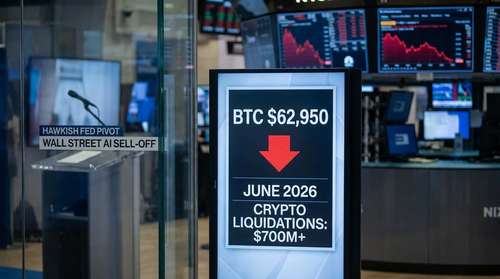

The cryptocurrency markets are reeling after a devastating overnight sell-off erased critical support levels. In what is already being dubbed the defining Bitcoin price crash June 2026, the flagship digital asset plunged to an intraday low of $59,018 between June 24 and June 25. This precipitous drop has pushed the premier cryptocurrency to its lowest valuation in 21 months, devastating leveraged traders and shifting broader market sentiment into a state of panic.
A convergence of macroeconomic headwinds—ranging from a surprisingly hot inflation report to a mounting AI stock capital rotation—has created a perfect storm for digital assets. With BTC below 60000, investors are now questioning whether this marks a temporary capitulation or the beginning of a deeper, prolonged risk-off phase in the broader financial landscape.
The Catalyst: PCE Inflation Crypto Market Impact
The immediate trigger for the steep sell-off can be traced directly to macroeconomic data released in the United States. The latest Personal Consumption Expenditures (PCE) report came in hotter than expected, showing inflation stubbornly persisting at 4.1% for May. As the Federal Reserve's preferred gauge for measuring price increases, this data sent shockwaves through both traditional equities and digital asset markets.
The PCE inflation crypto market impact was almost instantaneous. A hot inflation print heavily implies that the U.S. central bank will keep interest rates elevated for a longer duration, extinguishing any lingering hopes for imminent rate cuts. High-interest environments traditionally punish non-yielding, speculative assets like Bitcoin, as the opportunity cost of holding them increases. As traditional tech stocks and risk assets began to violently retract at the market open, Bitcoin moved in tandem, instantly shedding 5% of its value within a mere 30-minute window.
Massive Crypto Market Liquidation Exceeds $830M
The dip below the psychologically vital $60,000 threshold did not just spur spot selling; it ignited a vicious feedback loop. The swift downward movement triggered a staggering crypto market liquidation cascade, wiping out well over $830 million in leveraged derivatives positions across the board, with total market flush estimates exceeding $1 billion. The vast majority of the damage was inflicted on long traders who had boldly bet on a bounce from the $60,000 floor.
When highly leveraged long positions are clustered together around an obvious psychological support zone, a sudden break forces automated exchange closures. These liquidations necessitate aggressive selling into an already thin market, driving the price even lower and triggering the next batch of liquidations. Analysts warn that another dense cluster of long-side liquidity—totaling roughly $1.6 billion—sits perilously close to the $58,000 mark, which could spark an even more brutal wipeout if the bearish momentum is not halted.
Institutional Retreat and Bitcoin ETF Outflows
Adding severe downward pressure to the spot markets is the undeniable shift in institutional appetite. Over the past several weeks, the market has witnessed persistent, consecutive Bitcoin ETF outflows from U.S. spot products. In recent trading sessions leading up to the June 25 crash, cumulative net withdrawals reached roughly $5 billion, snapping a previously robust streak of institutional accumulation.
These outflows suggest that institutional players are not simply hedging their portfolios but are actively de-risking and trimming exposure. Without the steady influx of institutional capital that characterized earlier market rallies, the order books lack the necessary depth to absorb heavy selling pressure from both panicked retail investors and capitulating miners.
The Crypto Fear and Greed Index Plummets
Unsurprisingly, investor psychology has taken a massive hit. The widely monitored crypto fear and greed index has plummeted to a chilling score of 16, placing it deep into the "Extreme Fear" territory. The last time sentiment metrics languished at these depressed levels was during the market bottoms of previous severe bear cycles. While contrarian traders often view such extreme fear as a potential buying opportunity, the sheer speed of this drawdown has kept many sidelined.
Capital Flight: The AI Stock Capital Rotation
Beyond inflation fears and ETF selling, a structural shift in investment capital is quietly undercutting cryptocurrency valuations. Financial markets are currently witnessing a massive AI stock capital rotation, as institutional hedge funds, retail investors, and even Bitcoin miners pivot aggressively toward artificial intelligence and high-performance computing (HPC) equities.
Major data center operators and tech behemoths focused on AI infrastructure are absorbing the speculative capital that previously flowed into digital assets. Prominent mining companies, such as TeraWulf and IREN, are actively diversifying their business models, dedicating hundreds of acres and signing billion-dollar purchase agreements for computing systems to service managed AI cloud contracts. By converting their mined BTC into fiat to fund AI infrastructure expansions, these miners are inadvertently adding structural sell pressure to the market. Furthermore, traditional hedge fund managers are increasingly vocal about preferring the measurable growth of AI hardware and aerospace technologies over the macro-dependent swings of cryptocurrencies.
What Comes Next for Bitcoin?
With BTC below 60000, the market finds itself at a highly precarious juncture. The immediate focus for traders and analysts is the $58,000 to $59,000 support zone. If Bitcoin can stabilize here, the recent flush of excess leverage might reset the market for a healthier, organic recovery heading into the late summer months.
However, if the macroeconomic environment continues to sour and the Federal Reserve maintains a hawkish stance following the turbulent inflation data, further downside cannot be ruled out. For now, the combination of macroeconomic tightening, shifting technological trends, and a heavily leveraged trader base has served as a harsh reminder of cryptocurrency's enduring volatility.