
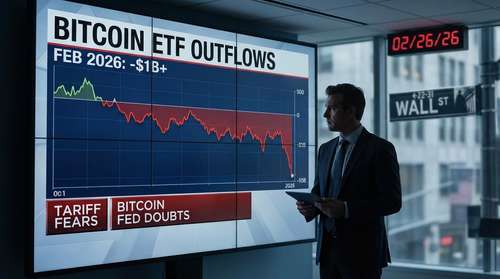
Institutional investors have withdrawn over $1 billion from Bitcoin and Ethereum ETFs in February 2026, marking a decisive shift in market sentiment as digital assets test critical support levels. This massive de-risking event, characterized by five consecutive weeks of net outflows, has pushed Bitcoin (BTC) dangerously close to the psychological $60,000 floor. The sudden liquidity drain is being driven by a perfect storm of macroeconomic headwinds: President Trump's newly announced 15% global trade tariffs and growing skepticism that the Federal Reserve will deliver a much-anticipated interest rate cut in March.
Institutional Crypto De-risking Accelerates
The scale of the capital flight is staggering. Data from late February 2026 indicates that U.S. Spot Bitcoin ETFs have recorded their longest streak of outflows since early 2025. Major institutional players are actively reducing exposure to risk-on assets, with year-to-date outflows now exceeding $4.5 billion. In February alone, the market witnessed a rapid acceleration of this trend, with a single week registering nearly $1.5 billion in withdrawals.
This institutional exodus isn't limited to Bitcoin. Ethereum ETFs have also mirrored this bearish momentum, shedding hundreds of millions as large allocators like hedge funds and asset managers retreat to cash positions. Reports from CF Benchmarks highlight that major funds, including Brevan Howard, have slashed their ETF holdings by as much as 86% in recent filings. The message from Wall Street is clear: the "cash-and-carry" arbitrage trade that fueled inflows in 2025 has evaporated, leaving spot prices vulnerable to raw selling pressure.
Trump's 15% Tariff Shock Rattles Markets
Adding fuel to the fire is the geopolitical uncertainty stemming from Washington. President Trump's administration recently escalated global trade tensions by raising the universal tariff rate to 15%, up from the previously discussed 10%. This move, announced following a Supreme Court ruling on executive trade authority, has sent shockwaves through global financial markets.
While Bitcoin initially showed resilience, holding near $68,000 immediately after the announcement, the delayed reaction has been severe. The specter of a renewed trade war—particularly with major partners like China and the EU—has dampened the risk appetite that cryptocurrencies rely on. Investors fear that these protectionist measures will reignite inflation, forcing central banks to keep borrowing costs high and tightening the liquidity tap that fuels crypto assets.
Fed March Rate Cut: Hope Fades to Skepticism
The cornerstone of the bullish case for a cryptocurrency market crash 2026 reversal was the expectation of easier money. However, those hopes are evaporating. Prediction markets now show a grim outlook for the Federal Reserve's March meeting, with the probability of a rate cut collapsing to single digits. The consensus trade has swiftly flipped to "Fed maintains rate," with over 90% of traders betting against a pivot.
This "higher for longer" narrative is toxic for non-yielding assets like Bitcoin. If the Fed remains hawkish to combat tariff-induced inflation, the opportunity cost of holding crypto increases significantly. The divergence between the Fed's cautious stance and the market's desperate need for liquidity is creating a vacuum where buyers are scarce, and sellers are aggressive.
Crypto Fear and Greed Index Hits Extreme Lows
The sentiment shift is quantifiable. The crypto fear and greed index has plummeted to readings between 5 and 11, firmly entrenched in "Extreme Fear" territory. These are levels not seen since the depths of the 2022 bear market. While contrarian investors often view such readings as a buy signal, the relentless nature of the current Bitcoin ETF outflows 2026 suggests that the capitulation phase may not be over.
Critical Support: Will Bitcoin Hold $60k?
Technical analysts are now laser-focused on the $60,000 mark. This price level represents more than just a number; it is a structural support zone that, if broken, could trigger a cascade of liquidations targeting the low $50,000s. Bitcoin is currently trading precariously in the low $60,000s, having already breached the $65,000 threshold that offered temporary respite earlier in the month.
The failure to reclaim $68,000 after the tariff news was a bearish signal that validated the institutional crypto de-risking thesis. With the Bitcoin price support 60k level under siege, the market is holding its breath. A decisive close below this level on high volume could confirm a medium-term trend reversal, potentially setting the stage for a prolonged "crypto winter" through the first half of 2026.