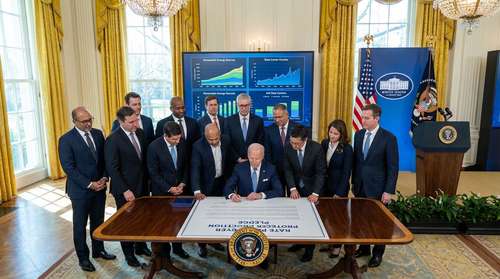
In a landmark move that could reshape the future of American energy and technology, leaders from the world's most powerful tech companies convened at the White House on March 4, 2026, to sign the Rate Payer Protection Pledge. This historic agreement, spearheaded by the Trump administration, mandates that tech giants like Microsoft, OpenAI, Meta, and xAI must self-fund the massive energy requirements of their next-generation artificial intelligence infrastructure. The initiative is designed to shield American families from surging electricity costs and grid instability while ensuring the U.S. maintains its lead in the global AI arms race.
Protecting Consumers from the AI Power Crunch
The core of the agreement addresses a growing fear among utility experts and consumers alike: that the insatiable energy appetite of AI data centers will drive up household electricity bills. Under the new Rate Payer Protection Pledge, signatories agree to "build, bring, or buy" their own power generation capacity for new facilities. This effectively decouples the skyrocketing demand of AI model training from the public grid's pricing structure, ensuring that the cost of innovation isn't passed down to the average ratepayer.
"We are establishing a simple principle today: if you need the power of a small city to train your AI, you need to build the power plant to run it," President Trump remarked during the signing ceremony. The pledge marks a significant shift in tech infrastructure regulation, moving away from taxpayer-subsidized grid expansions toward a model where Big Tech bears the full burden of its energy consumption. White House officials estimate this could save American households billions in potential rate hikes over the next decade.
Microsoft and OpenAI's Nuclear Ambitions
One of the most significant commitments comes from the Microsoft-OpenAI alliance, which has been aggressively pursuing independent power solutions. As part of their compliance with the pledge, Microsoft OpenAI power generation plans have accelerated, with the companies confirming massive investments in Small Modular Reactors (SMRs) and confirming the restart of dormant nuclear facilities to feed their data centers directly.
Brad Smith, Vice Chair and President of Microsoft, emphasized that the company's strategy goes beyond mere compliance. "Our commitment to the White House AI summit 2026 is not just about cost; it's about reliability. By generating our own carbon-free nuclear energy, we ensure our AI services remain online without straining the local communities where we operate." This aligns with OpenAI's long-term goal of securing gigawatt-scale power for their upcoming frontier models, a scale of energy usage that traditional renewable sources struggle to provide consistently.
xAI's Energy Independence Strategy
Elon Musk, a vocal proponent of energy autonomy, used the summit to showcase Elon Musk xAI energy strategy. Unlike his competitors who are leaning heavily into nuclear partnerships that may take years to mature, xAI is deploying rapid-response natural gas generation and massive battery storage arrays at its "Colossus" supercomputer sites. Musk stated that xAI's facilities would be capable of operating in "island mode," completely disconnecting from the public grid during peak demand hours to prevent blackouts.
The Rising Cost of AI Electricity
The urgency of this summit is underscored by the staggering projections of AI data center energy consumption. Recent reports indicate that by 2028, AI data centers could consume as much electricity as the entire country of Japan. Without the safeguards introduced by the pledge, AI electricity costs were projected to cause double-digit percentage increases in utility bills for residents in data center hubs like Northern Virginia and Arizona.
The pledge also introduces a transparency mechanism. Tech companies must now publicly report their "grid impact" quarterly, demonstrating that their new consumption is being met with new generation capacity. This level of accountability is unprecedented and aims to prevent companies from quietly absorbing municipal power reserves.
A New Era of Tech Infrastructure Regulation
While the pledge is technically voluntary, the administration has framed it as a precursor to stricter tech infrastructure regulation if companies fail to comply. The agreement effectively creates a two-tiered energy system: a public grid for residential and commercial use, and a private, self-funded energy grid for high-density computing. This separation is seen as vital for modernizing America's aging power infrastructure without bankrupting consumers.
Critics, however, warn that enforcement will be the real test. "Signing a pledge is the easy part," notes energy analyst Dr. Sarah Jenkins. "Actually permitting and building new power plants in the United States is notoriously difficult. If these companies can't get their reactors and turbines approved, they may be forced back onto the public grid, pledge or no pledge." Despite these challenges, the March 4 summit represents a critical acknowledgment that the digital future cannot come at the expense of the physical grid.