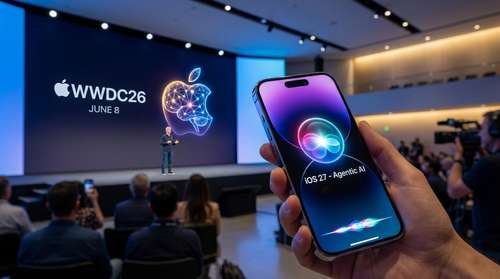
Apple has officially marked its calendar. The highly anticipated Apple WWDC 2026 will officially kick off on Monday, June 8, running through June 12. While the annual developer conference at Apple Park typically serves as a software showcase, this year's keynote promises a fundamental shift in how we interact with our devices. At the center of the stage will be iOS 27, an update expected to ditch the passive chatbot models of the past in favor of a proactive, autonomous ecosystem. This marks the beginning of the Agentic AI revolution.
Unpacking the iOS 27 Features Expected at Apple WWDC 2026
Recent announcements confirm the June 8 keynote will serve as the launchpad for Apple's next-generation operating systems, including iPadOS 27, macOS 27, and watchOS 27. However, the spotlight remains firmly on iOS 27 features. Industry insiders reveal that Apple is moving beyond standard generative text. Instead, the company is embracing agentic workflows—AI systems designed to independently chain together complex tasks across multiple applications without requiring constant human prompting.
If you ask your device to organize a trip, the new framework won't just draft an itinerary. It will scan your Mail for flight confirmations, cross-reference your Calendar for scheduling conflicts, and interface with third-party travel apps to finalize bookings. This shift aligns perfectly with broader tech industry trends 2026, where autonomous digital agents are rapidly replacing reactive voice assistants. To achieve this smoothly, iPhones must cross what analysts are calling the Agentic Threshold. Running these models locally requires significant memory overhead, pushing Apple to lean on its 8GB RAM baseline across modern device lineups to ensure fluid, on-device processing.
The Power Behind the Scenes: Siri Gemini Integration
To process these heavy computational demands, Apple is fundamentally rethinking its infrastructure. The upcoming Apple Intelligence upgrades rely heavily on a reported multi-year, $1 billion strategic partnership with Google. By anchoring the Siri Gemini integration deep within the operating system, Apple is combining the nuanced reasoning of Google's Gemini 3 models with its own proprietary Apple Foundation Models.
This hybrid architecture solves a critical computing bottleneck. Simple requests will continue to run locally on Apple Silicon to ensure strict data privacy. For multi-step, complex reasoning, the system hands off the workload to Private Cloud Compute (PCC) servers powered by Gemini. The result is a dramatically smarter Siri that maintains Apple's stringent data security standards while executing sophisticated cross-app commands.
Breaking Down the Latest Agentic AI News
The transition toward an agent-driven ecosystem is already making waves across enterprise and consumer sectors. According to recent Agentic AI news, healthcare and personal productivity are two major pillars of Apple's 2026 strategy. Developers are anticipating massive overhauls to HealthKit, where an agentic Siri could autonomously analyze sleep patterns, cross-check heart rate anomalies, and proactively verify insurance copays for a new medication.
This leap in iPhone AI technology fundamentally changes the mobile user experience. You will no longer need to micro-manage your smartphone. Instead of acting as a digital filing cabinet, your iPhone becomes an active orchestrator of your daily routines. It is a philosophy that positions artificial intelligence as an invisible, friction-free utility rather than a standalone novelty application.
Empowering Developers with Agentic Coding
The autonomous revolution extends far beyond consumer-facing software. Pre-WWDC software updates, such as the release of Xcode 26.3, signal a major pivot in how applications will be built. Apple is officially supporting agentic coding, allowing developers to plug autonomous agents directly into their Integrated Development Environments. These tools can independently search documentation, explore file structures, and iterate on code until a build succeeds. For the developers tuning into the keynote, the primary focus will shift from simply writing code to orchestrating intelligent systems.
Hardware Impacts and the Future of macOS 27
Software rarely evolves in a vacuum, and the sheer demands of agentic computing will inevitably influence upcoming hardware reveals. Beyond the mobile ecosystem, Apple WWDC 2026 will serve as a definitive turning point for the Mac lineup. Current developer data suggests macOS 27 will finally drop all support for legacy Intel processors, optimizing the entirely Apple Silicon-based ecosystem for heavy machine learning workloads.
Additionally, developers are expecting new APIs designed to lay the groundwork for the heavily rumored iPhone Fold. Preparing the developer community for foldable displays and potentially touch-centric Mac interfaces requires distributing the necessary tools early. When Tim Cook takes the stage this June, the underlying message will be clear: the hardware foundation is set, but autonomous, agentic software will define the next decade of computing.